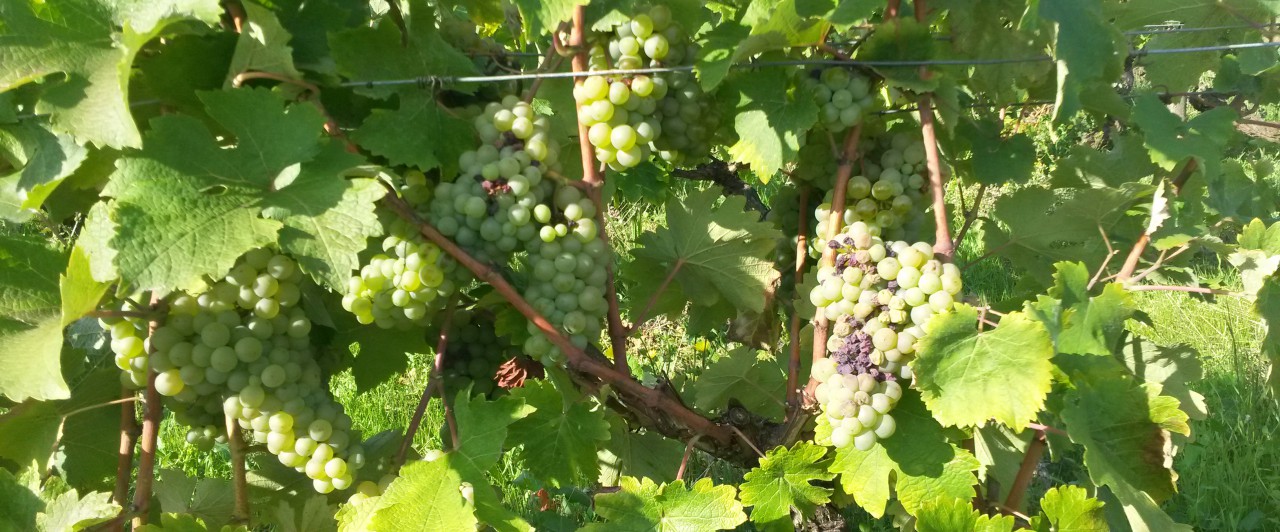
Alsace wines aren’t the most fashionable wines nowadays, but this reputation isn’t because of a lack of quality.
Domaine Bruno Sorg isn’t the most fashionable winery of the Alsace, but that reputation isn’t because of a lack of quality.
Muscat isn’t the most fashionable grape in the Alsace, but that reputation isn’t because of a lack of quality.
I hope that after having read this post some of you will want to go and discover the fantastic diversity and quality of Alsace wines, experience the brilliance of one of the lesser known winemakers in Alsace, and try wines made from the rarest of Alsace grapes; Muscat.
Domaine Bruno Sorg is based in the typical Alsace village of Eguisheim, near Colmar. Many fine domaines share this location with Sorg; Paul Ginglinger, Léon Beyer, Joseph Cattin, Wolfberger, Paul Zinck, to name a few.
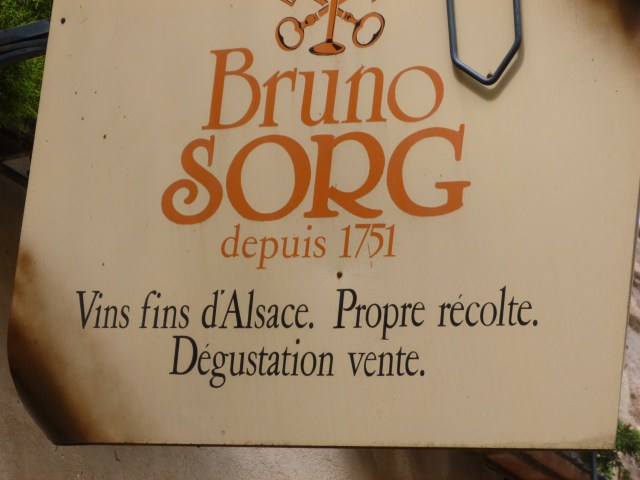
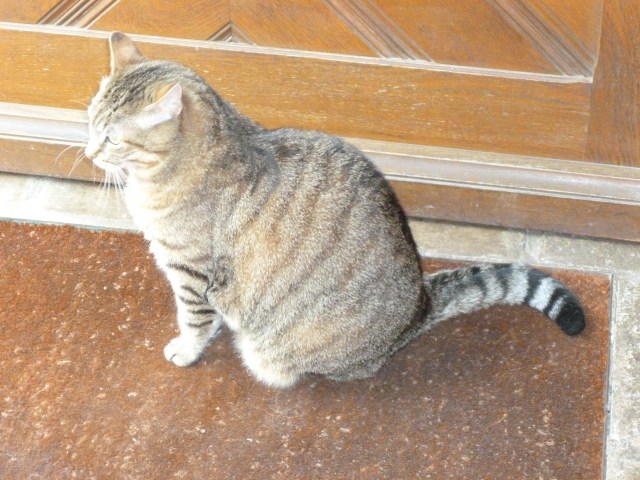
Behind a heavy wooden gate a courtyard leads the way to Sorg’s tasting room. This is a modest affair with a small bar, a few tables and chairs, and a big cat that keeps watch over proceedings. You wouldn’t know you just stepped into the realm of one of the most talented producers in all of Alsace. This is not the slick operation one will find with Hugel or Marcel Deiss, with many staff milling about, fancy automatic doors, and colourful brochures. No, here you will find a printed A4 with a relative small number of wines, mostly only of the latest vintage. But what it lacks in numbers, it makes up in quality.
Alsace Muscat is actually made up of three varieties; Muscat Ottonel, Muscat Blanc à Petit Grains, and Muscat Rosé à Petit Grains (the latter being just a pink-skinned clone of the former). Muscat à Petit Grains is less aromatic compared to Muscat Ottonel, but the wines are often fuller bodied and flavoured. Some producers favour one over the other, although most produce wines that are a mixture of the two types. What is typical of Alsace is that most Muscat is vinified dry. Sweet Muscat is well known in the form of Samos Muscat, Muscat de Cap Corse, Muscat de Rivesaltes, and Muscat de Beaumes de Venise. Dry Muscat is not only much more rare, but also a lot less known. Examples of dry Muscat are found in Portugal, Italy, Romania, and Crete.
Sorg produces two Muscats; a generic ‘Tradition’ and a ‘Grand Cru’.
The 2012 Muscat Tradition that I tasted in 2014 had good concentration, not the strongest bouquet I ever smelled on a Muscat, but still had that typical grapey Muscat nose with some floral notes. The taste was fresh, dry, with good acidity, grape coming back on the palate. Medium long finish. A very pleasant wine.
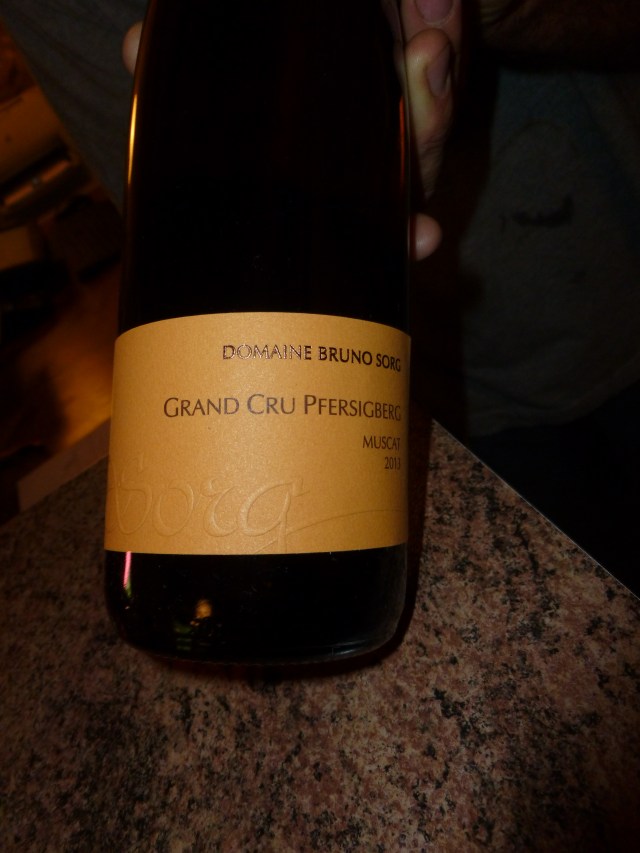
The 2013 Muscat Grand Cru Pfersigberg is a mixture of (mostly) Muscat Blanc à Petit Grains and Muscat Ottonel. The nose is strongly floral and grapey. Peachy notes come through when tasting. Combined with excellent refreshing acidity and a good body this makes a very serious and majestic Alsace Muscat. It is indeed among the best Alsace Muscat I have ever tasted. Its reputation is well deserved.
So what do we eat with these wines? Actually they both make fantastic aperitifs. The Grand Cru Pfersigberg is more so a food wine than the Tradition, which is a bit light. White asparagus served with ham would go very nicely with both wines. The Grand Cru can take on lighter style Thai or Vietnamese dishes too. But either with food, or as an aperitif, you should try these wines. And if it isn’t Bruno Sorg’s Muscat, consider trying another Alsace Muscat. It is such a welcome and refreshing change from the mass produced Chardonnay’s, Pinot Grigio’s, and Sauvignon Blanc’s of this world.
 Dutch Courage